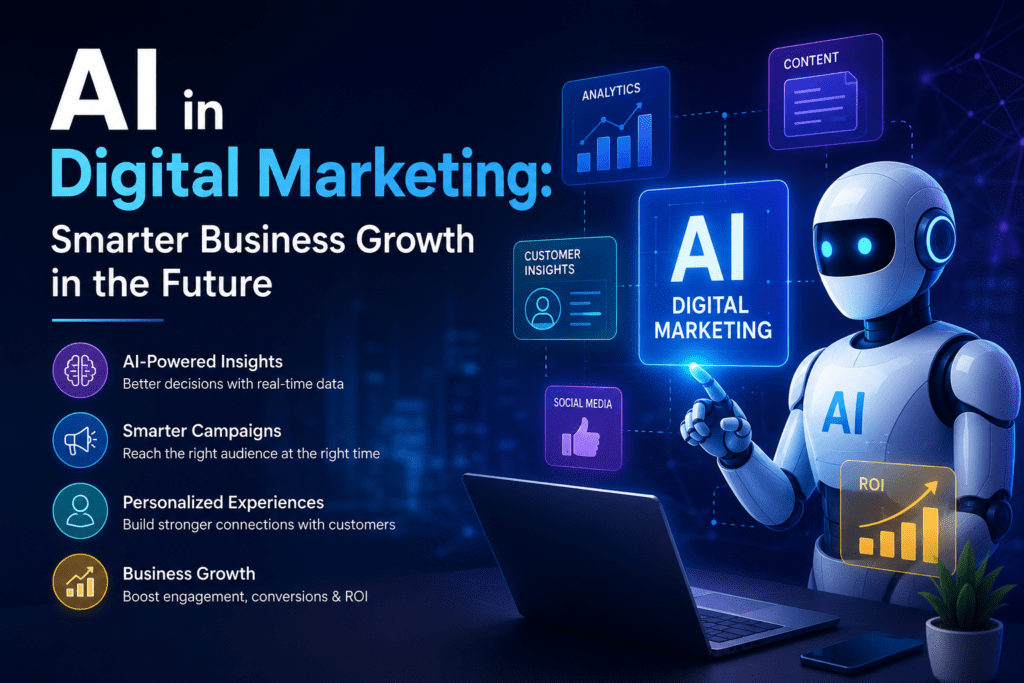
AI in Digital Marketing: Smarter Business Growth in the Future
AI in digital marketing is transforming the way businesses connect with customers, optimise campaigns, and drive measurable growth. Over the last decade, the industry has evolved rapidly, and artificial intelligence has become one of the biggest drivers of that change. Whether you run a startup or a large enterprise, understanding this technology is no longer optional — it is a core requirement for staying competitive in today’s online landscape. With the power of intelligent automation, companies are gaining a strong competitive edge by streamlining repetitive tasks, analysing customer interactions, optimising campaign performance in real time, and delivering truly personalised experiences at scale. By implementing data-driven strategies, businesses can make smarter, faster decisions while making the most of their marketing budgets. At Digi Dhurandhar, we keep a close eye on emerging technologies and trends to provide our clients with the most relevant, up-to-date insights. Based on years of industry experience, we know that artificial intelligence is no longer a future possibility — it has become a primary strategic element of every successful digital marketing plan today. What Is AI in Digital Marketing? AI in digital marketing refers to the use of computer algorithms that can perform tasks which would ordinarily require human intelligence. These tasks include learning from input data, identifying patterns and relationships, making data-based predictions, enabling natural language conversations, and automating complex decisions. In the world of marketing, these intelligent systems give companies the ability to process enormous volumes of consumer data and convert it into actionable insights — far faster and more accurately than traditional methods allow. Key AI Applications in Marketing Intelligent tools are now applied across a wide range of marketing use cases, including: • Data Analysis and Interpretation • Customer Behaviour Prediction • Content Creation Support • Marketing Automation • Personalised Recommendations • Campaign Optimisation • Audience Segmentation • Automating Customer Support By leveraging these capabilities, businesses achieve greater operational efficiency while creating more relevant and engaging experiences for their audiences. The Growing Importance of AI in Marketing Consumer expectations have evolved significantly. Today’s customers expect brands to know what they want, how they like to shop, and what products or services interest them. Conventional marketing practices often struggle to meet these expectations because they rely primarily on manual data analysis and are limited to smaller sample sizes. Intelligent marketing technology addresses this challenge directly. Here is how it helps businesses overcome traditional limitations: • Instantaneously processing vast quantities of consumer data • Discovering previously unknown customer behaviour patterns • Improving the precision and targeting of advertising efforts • Creating more relevant and personalised consumer experiences • Reducing the overall cost of marketing operations • Increasing marketing efficiency and output at scale With growing competition across every industry, businesses that delay adopting these technologies risk losing visibility, audience engagement, and market share to more agile competitors. How AI in Digital Marketing Powers Every Marketing Channel Modern marketing tools powered by artificial intelligence have integrated into almost every aspect of online marketing. From content and SEO to paid ads and customer support, smart technology is reshaping how brands operate across all digital channels. AI-Powered Content Creation The growing adoption of AI in digital marketing has made content creation faster, smarter, and more data-driven than ever before. Content remains the most important foundation of any strong digital strategy. Businesses need a constant supply of blog posts, social media content, product descriptions, emails, and website copy. AI-assisted tools support marketers in producing this content far more efficiently. What AI Content Tools Help With • Generating content ideas and topic clusters • Creating structured content outlines • Improving readability and flow • Headline optimisation for click-through rates • Keyword suggestions for on-page SEO • Enhancing overall content structure It is important to note that while intelligent tools accelerate content production, human expertise remains essential for ensuring originality, factual accuracy, brand voice, and trustworthiness in all published content. Smart Customer Segmentation Customer segmentation is one of the strongest use cases of AI in digital marketing because it enables businesses to deliver highly personalised experiences. Customer segmentation involves dividing an audience into groups based on shared characteristics such as behaviour, demographics, interests, and purchasing habits. Intelligent segmentation tools have dramatically improved this process by analysing: • Browsing behaviour and on-site navigation patterns • Past purchasing behaviours and transaction history • Engagement patterns across email, social, and web channels • Device preferences and usage habits • Geographic location and regional trends The result is that marketers can create highly targeted campaigns tailored precisely to each customer segment, resulting in stronger engagement and higher conversion rates. Using AI in Digital Marketing for Search Engine Optimisation One of the most valuable applications of AI in digital marketing is search engine optimisation. Businesses can use AI in digital marketing to identify keyword opportunities, understand search intent, and improve content performance. Search Engine Optimisation (SEO) remains one of the most valuable long-term strategies in digital marketing. Modern SEO revolves around data analysis, understanding user intent, and creating content that satisfies both users and search engines. Intelligent SEO tools make all of this smarter and more efficient. Marketers applying these tools for SEO can: • Identify new, high-opportunity keywords to target • Evaluate the SEO tactics of market competitors • Discover content gaps and topical authority opportunities • Improve website speed and overall technical performance • Automate and enhance technical SEO audits • Understand the true intent behind specific search queries How Smarter SEO Helps Increase Organic Traffic Businesses that implement data-driven SEO strategies typically see measurable improvements, including: • Higher search engine ranking positions for target keywords • Increased click-through rates from organic search results • Greater content relevance in the eyes of search engines • Better engagement metrics from website visitors • Sustained growth in organic traffic over time While automation handles many SEO tasks, successful search optimisation still depends on strategic planning and deep industry knowledge. AI-Driven Paid Advertising AI in digital marketing allows advertisers to optimise campaigns in real time, ensuring better